
How I Manage Multiple Projects Without Losing My Mind
Lessons from 25 years of juggling programs, people, and priorities.

Every delivery leader eventually faces the same nightmare: you’re deep in a steering committee meeting, slide decks flickering on the screen, executives nodding along—and suddenly three different projects are all demanding your attention at once. One team is racing toward an unrealistic deadline, another is stuck on a dependency outside their control, and a third has just revealed a budget overrun nobody saw coming. Managing one project under those conditions is stressful enough. Managing five or six simultaneously feels like juggling flaming swords while riding a unicycle. I know, because I’ve been there—many times.
At Microsoft, I have led multiple parallel initiatives, each with different stakeholders, roadmaps, and reporting rhythms. Every day felt like herding cats. And yet, with the right practices, we not only delivered—we delivered outcomes that mattered.
That experience taught me something simple but powerful:
Managing multiple projects isn’t about doing more. It’s about building systems that create clarity, alignment, and momentum.
Here’s what has worked for me over 25 years in delivery leadership.
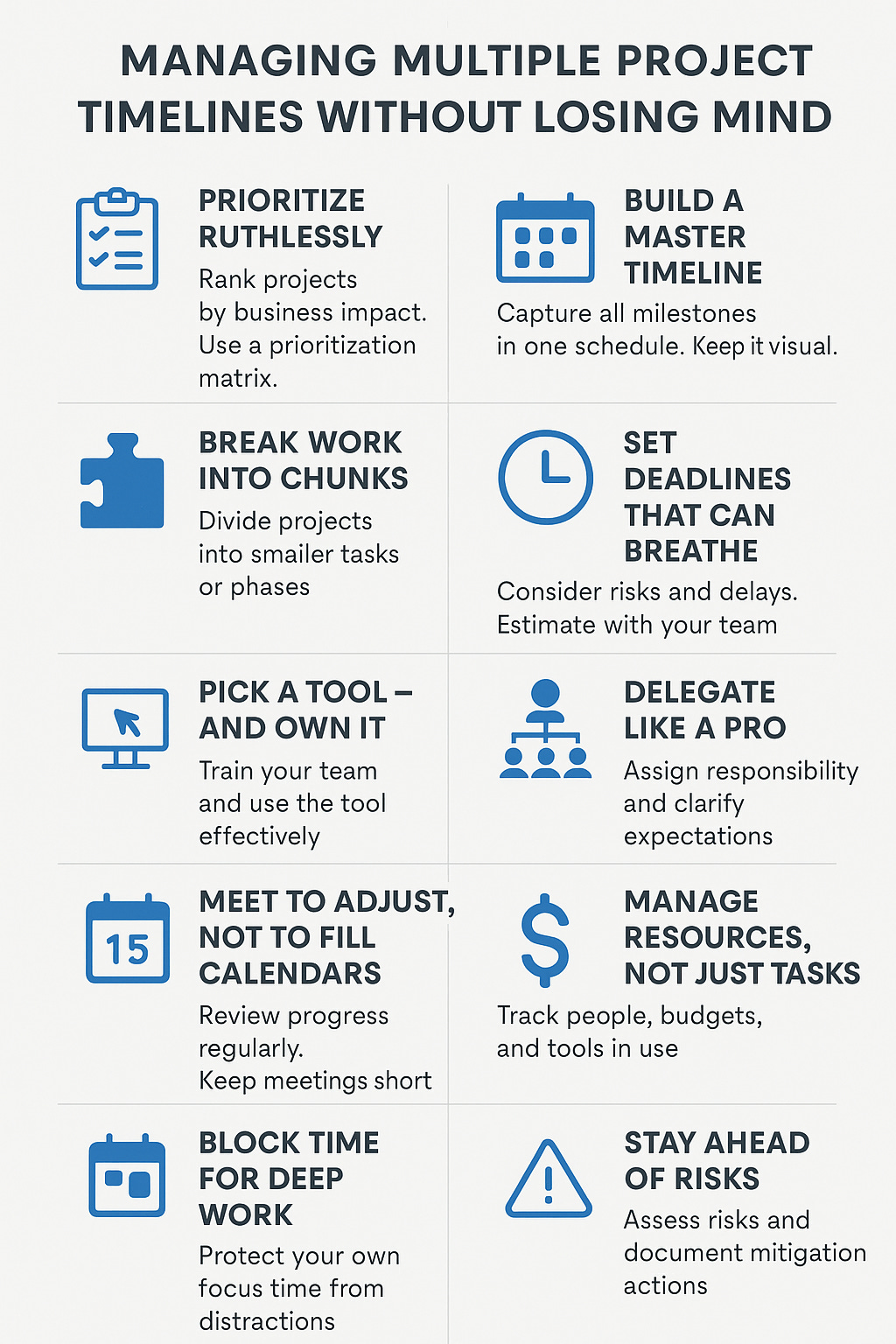
1. Prioritize Ruthlessly
Not every project deserves equal love, though it took me years to understand that. Early in my career, I made the mistake of spreading myself evenly across every initiative, as if each one carried the same weight. I was constantly busy, pulled in multiple directions, and running on fumes—but I wasn’t truly effective.
The turning point came when I began asking a different question: which of these projects will actually move the business forward? That question alone shifted how I allocated my time, attention, and resources. Suddenly, it wasn’t about treating everything as urgent—it was about separating the critical few from the trivial many.
A simple prioritization matrix—business impact on one axis, urgency on the other—proved far more reliable than gut feel or politics. It made my decision-making transparent and defensible, and it gave teams clarity on why some initiatives got more energy than others. Focus became a leadership act, not a gamble.
2. Build a Master Timeline
When teams keep their own separate timelines, chaos is inevitable.
I once reviewed three different “project plans” for the same initiative—each showing different dates. Guess how confident the executives were? Zero.
The fix is simple: consolidate into one master timeline. A single source of truth.
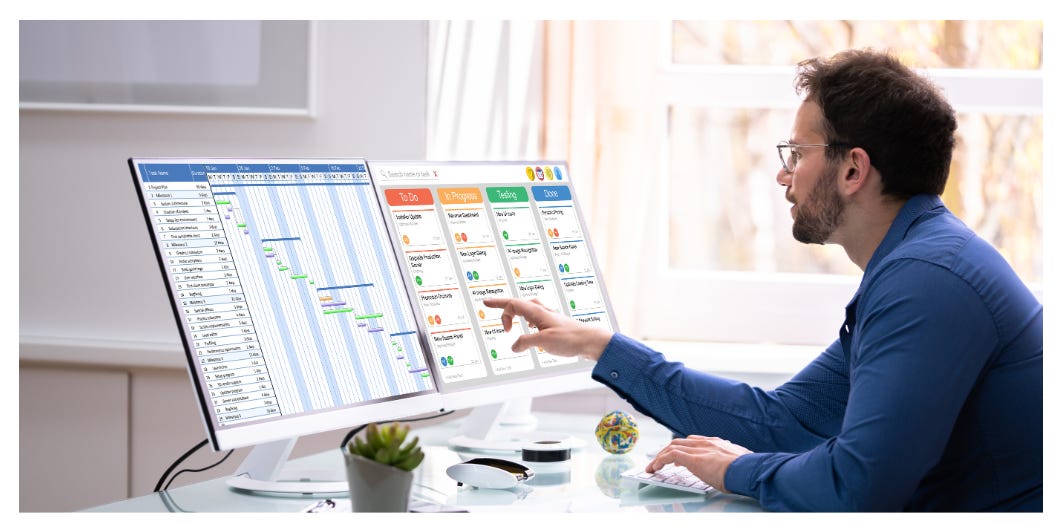
It doesn’t have to be fancy—sometimes a shared spreadsheet works better than the latest AI-driven tool. What matters is visibility. If everyone sees the same milestones, you prevent weeks of misalignment.
3. Break Work Into Chunks
A twelve-month program can feel overwhelming when you look at it as one massive block of work. It’s like standing at the base of a skyscraper and trying to imagine how you’ll ever reach the top. The scale itself creates fog, and that fog breeds anxiety.
The way out is to break it down into digestible phases—think Lego blocks instead of a single monolith. When I structure programs this way, I rely on incremental milestones that create visible markers of progress. Smaller chunks are easier to manage, easier to adjust, and they bring risks to the surface long before they become disasters.
Teams respond well to this approach too. A mountain is intimidating; a series of steps is achievable. Each milestone feels like a win, and that momentum carries people forward.
4. Set Deadlines That Can Breathe
I’ve lost count of the times I’ve seen teams plan for “best case” timelines. Everything looks neat in the Gantt chart: dependencies line up perfectly, tasks flow from one milestone to the next, and the program manager proudly declares the launch date as if it’s carved in stone.
But here’s the uncomfortable truth: deadlines slip. Priorities shift. Risks emerge when you least expect them. Pretending otherwise doesn’t make you look strong—it makes you look naïve.
The best delivery leaders don’t cling to the fantasy of perfect execution. They build room for reality. They plan with buffers, they factor in risk, and they design schedules that can bend without breaking. That flexibility is what keeps teams sane when the inevitable surprises arrive.
One trick I use: involve the people actually doing the work in estimation. They’ll give you better inputs than any top-down directive. Add buffers. Build flexibility. It’s not weakness—it’s realism.
5. Pick a Tool—and Own It
Tools don’t run projects—people do. But the right tool, used consistently, can make the difference between order and chaos.
During my time at Microsoft, I’ve seen teams use everything from lightweight Azure DevOps boards to sprawling MS Project schedules with hundreds of lines. And the truth is, the specific tool matters far less than leaders often assume. What matters is whether the team actually uses it, and whether it becomes a shared language rather than a black box.
A good tool supports your system; it doesn’t dictate it. If you ever feel like the tool is running you—demanding more attention than the work itself—you’ve picked the wrong setup. The goal is clarity, not complexity.
6. Delegate Like a Pro
One of the hardest lessons I had to learn was that you can’t own everything. Early in my career, I believed that being across every detail made me indispensable. I hovered in meetings, reviewed every deliverable, and tried to anticipate every issue before anyone else could. At first, it felt like control. In reality, it just made me exhausted—and it slowed everyone else down.
True delivery leadership isn’t about clutching every task. Delegation isn’t abdication; it’s leadership. The real skill is in assigning ownership clearly, communicating expectations upfront, and then trusting people to deliver. Tools like a RACI matrix—defining who is Responsible, Accountable, Consulted, and Informed—can be helpful. But only if they are used to empower rather than to micromanage. The moment you use them to tighten your grip, you defeat their purpose.
7. Meet to Adjust, Not to Fill Calendars
We’ve all sat through those endless status meetings that drag on without producing a single useful outcome. Slides are shared, updates are read aloud, and by the end, nobody is clearer than when they walked in. It’s a ritual of time-wasting that masquerades as progress.
Over the years, I’ve learned to treat meetings differently. For me, they are pit stops, not endurance tests. Their purpose is simple: to surface risks, adjust timelines, and align on key decisions. Nothing more. If a meeting doesn’t create clarity or momentum, it doesn’t belong on the calendar.
This discipline does more than protect my own time—it builds respect for everyone else’s. Teams notice when you guard their calendars and only bring them together when it matters. It shows that you value their focus, not just their presence.
8. Manage Resources, Not Just Tasks
A project plan can look immaculate on paper and still be on the path to failure. Why? Because resources are misaligned. You can have the neatest Gantt chart in the world, but if the people, budgets, or tools aren’t in place, the plan is nothing more than a work of fiction.
I remember one program where the schedule was flawless. Every dependency mapped, every milestone locked in. On paper, it looked bulletproof. In reality, the team had just been cut in half due to reassignments. The delivery never stood a chance.
That’s why I always ask a simple question: how are resources actually being consumed? The bottlenecks usually show up there first. And resource tracking doesn’t have to be elaborate. Even a short weekly check-in with the team can reveal cracks before they widen into full-blown failures.
9. Block Time for Deep Work
Managing multiple projects almost guarantees constant context-switching. One moment you’re reviewing a budget forecast, the next you’re pulled into a technical escalation, and before you can catch your breath, a stakeholder is asking for a status update. It’s easy to spend entire days reacting, without ever doing the deeper work that actually moves programs forward.
But the real value of a delivery leader isn’t in firefighting—it’s in problem-solving. And problem-solving requires focus. That’s why I deliberately block time on my calendar for deep work. No meetings. No Slack. No email. Just space to think, design, and strategize.
At first it can feel indulgent, almost selfish, to protect this time. But it’s not. It’s the only way to stay ahead of the chaos instead of being consumed by it. Those quiet hours are when the most complex risks get untangled, when strategy replaces noise, and when clarity replaces overwhelm.
10. Stay Ahead of Risks
One of the biggest mistakes I see in project delivery is the belief that if you don’t mention a risk, it somehow doesn’t exist. Risks don’t vanish when ignored—they compound. The small issues you gloss over in status reports often become the crises that derail entire programs.
That’s why I make risk management a regular rhythm. I run reviews, I document mitigation strategies, and I bring them into conversations with stakeholders—even when the news isn’t pleasant. People don’t always like hearing about risks. But in my experience, they dislike surprises far more.
Proactive risk management is what separates controlled course-corrections from last-minute disasters. It’s not about eliminating uncertainty; it’s about creating enough foresight and honesty to handle the inevitable bumps in the road before they become roadblocks.
Look, managing multiple projects will never be simple. It will always feel messy.
But clarity beats chaos. Systems beat stress. And leadership beats firefighting.
I don’t claim to get it right every time. Projects still slip. Risks still bite.
But by practicing these habits, I’ve turned the overwhelm of “too many projects” into something far more powerful: momentum across multiple fronts.
That’s the real work of delivery leadership.
Over to you: If you’re managing multiple projects right now, which of these practices resonates most? Or what’s one technique you use that isn’t on this list?
I’d love to hear your stories in the comments.
Great points Rajesh. This post made me to think a lot around these topics. I have tried add few points based on my experience.
Prioritise ruthlessly :
Ensure your stakeholders are perfectly aligned with your prioritization rationale and the project team gets a bigger picture of why an activity has been prioritized.
Break work into chunks :
Though we had a systematic stage gates dividing the bigger projects into small chunks, I used to find the project team loosing focus in multiyear programs. Team moral and momentum changed dramatically, when we celebrated periodic small wins and emphasized on how these wins contributed to the larger project goal.
Build a master timeline :
Multiple Gantts in single view.
I use MS project “Sub projects” feature to keep the schedule of all the project I am leading in a single Gantt chart. It helps me to plan in a given-time, which project needs my attention. It could also be used to manage shared resources effectively.
Set deadlines that can breath :
Build risk driven buffers
Rather than adding generic buffers, create your buffers based on the risks (Probability of the risk and its impact on the schedule) in each stages/milestones. This rationalization helps you push back schedule reduction asks, effectively.
Pick a Tool—and Own It
Use the tool which works best for the user/audience. While I always manage a master schedule on MS project for planning and control, I use MS Project reports, Dashboards and powerpoint office timeline to communicate it efficiently to different audiences.
Delegate like a Pro
Only a leader who has no insecurity, delegates. Trust by default- A leader should trust his/her team to deliver.
Meet to Adjust, Not to Fill Calendars
Meetings should be outcome based, either to arrive at a decision, or to get an alignment etc. In my experience, short meetings with clear agenda brings out best value. If your meeting is going for hour/hours, its not a meeting, its a workshop.
Manage Resources, Not Just Tasks
It’s the job of PM to guard the cross functional team from shifting priorities, re-assignments and unplanned “small favors”. Build a trust worthy safe environment where those resources reach out to you if they find challenges meeting project goals.
Block Time for Deep Work
Multi-tasking is an inefficient way of working, context-switching wastes a lot of productive time. I use time-blocks to be productive, 30 mins of focused work on a single topic(Deep work/ Problem solving), followed by 15 mins of juggle (Emails, Chats etc)
Stay Ahead of Risks
I encourage my team to consider listing maximum risks as an achievement, additionally, while brainstorming for risks, I ask them to not to worry about how any risk is common, simple or important. Risk review is not a one time job, it’s a live document. To get a confidence
on a project or project manager, I always look at their risk register.
I've begun blocking time for 3 priorities or big rocks that actually make a difference each week.
A Master Action Log tracker helps me not lose sight of the small tasks.