
What Actually Gets You Hired at Big Tech
And why it's not as simple as Influencers tell you!

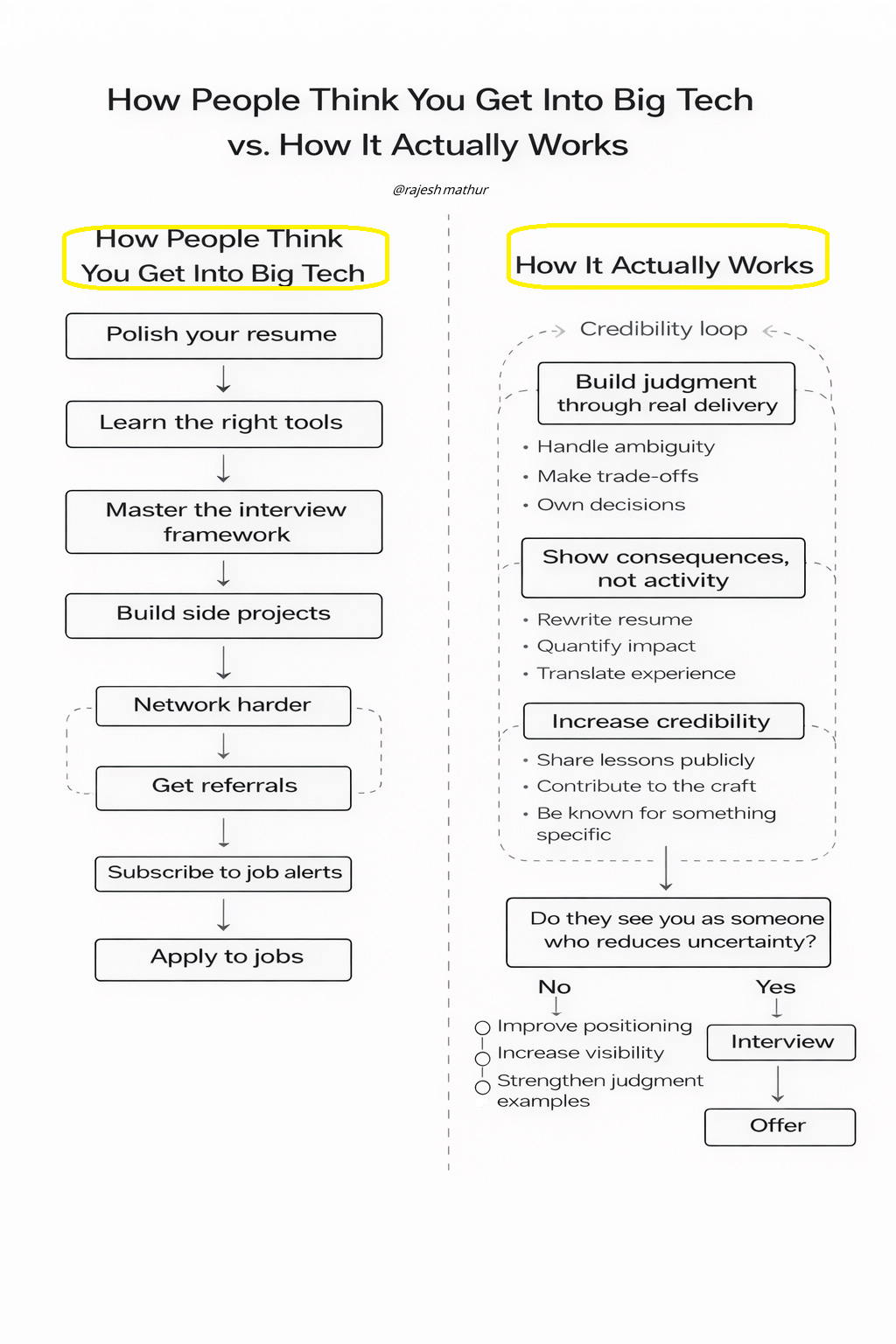
Every year, I see articles, YouTube videos and LinkedIn posts promising a shortcut into Big Tech roles. Polish your resume. Learn the right tools. Master the interview framework. Build side projects. Network harder.
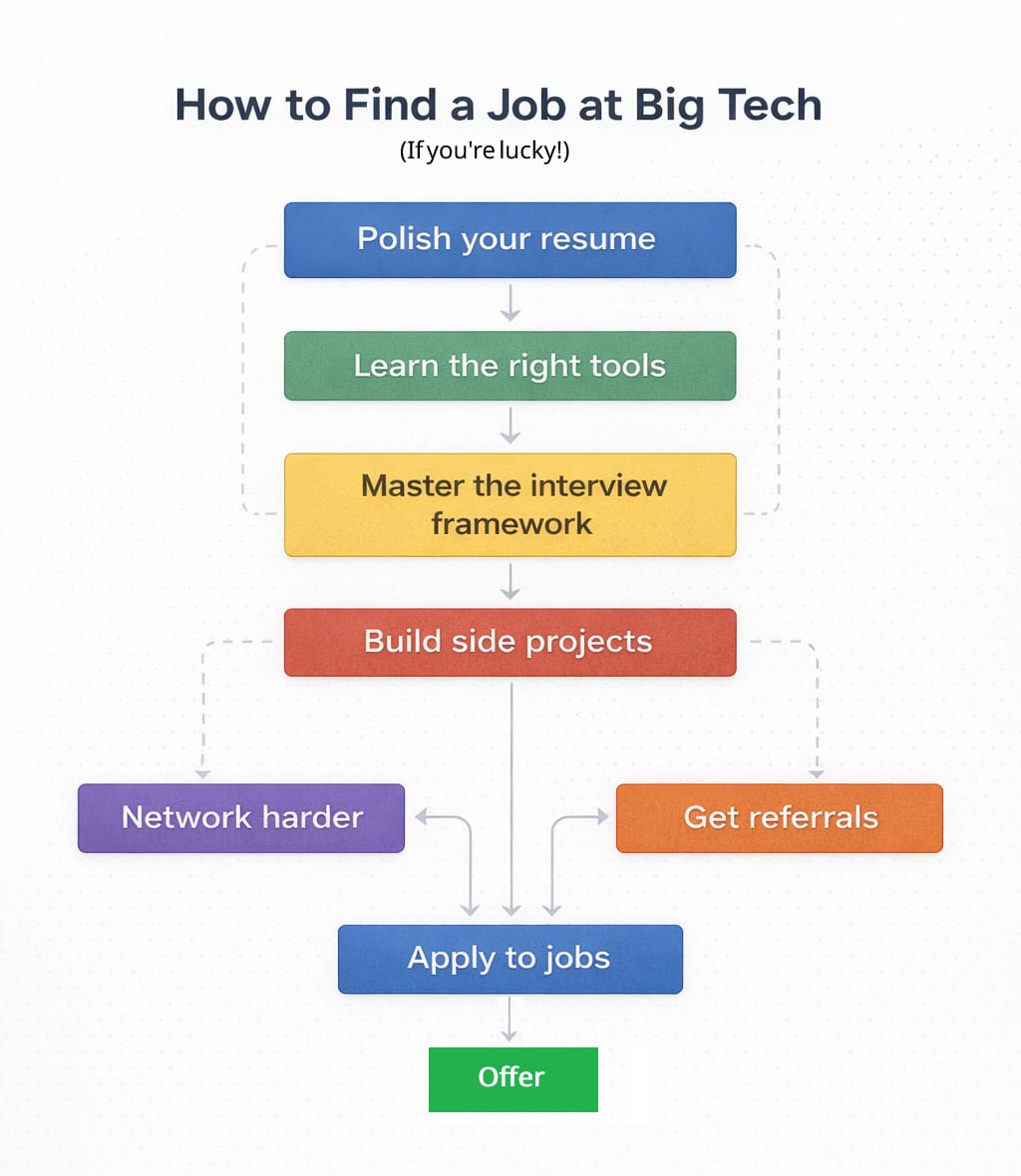
Most of that advice is written for engineers and is too simplified.
Very little of it reflects how Project and Program Managers are actually evaluated, hired, and trusted in large technology organisations today.
I have spent over two decades inside large, complex environments across aviation, telecom, banking, government, and now large-scale data and AI programs. I have interviewed PMs, mentored them, coached them, and watched others stagnate despite working harder than anyone else in the room.
Here is the reality -
Big Tech does not hire Program or Project Managers because they are good at events (ceremonies), tracking tasks, or writing documents. Those are table stakes, and in many cases they are automated, templated, or delegated. If they are not yet automated, then there is huge chance that they are in the process of being automated. Microsoft Planner with Project Manager Agent does that well.
They hire PMs because they reduce uncertainty for leadership.
If you want to break into a Big Tech PM role in 2026, or grow inside one without plateauing, you need to understand what that actually means and how to demonstrate it before you are even in the room.
1. Understand what Big Tech is really evaluating
I know that the first advice you get is: align your CV/ resume with the job description. No, nothing is wrong with that and it is wise to do that while applying for a job at BigTech. However, job descriptions will not tell you everything you need to know.
Job Descriptions list stakeholder management, risk tracking, cross functional coordination, and delivery ownership. All of that is necessary, but none of it differentiates you. Almost every applicant can claim those capabilities.
What hiring managers are actually trying to assess is whether you can operate in ambiguity, surface difficult truths early, and influence people who do not report to you. They want to know whether you can hold a room steady when timelines move, dependencies fall apart, or when leadership pressure increases.
In other words, they are evaluating judgment.
If your application positions you as someone who runs process efficiently, you will blend in. If it positions you as someone who improves decision quality and makes complex environments more navigable, you will stand out.
That shift in framing changes everything that follows.
2. Write a resume that proves impact, not effort
Most PM resumes describe motion or action rather than consequence. They mention the number of teams involved, the cadence of meetings, or the size of the budget. Those details matter, but only in context.
What matters more is what changed because you were there.
Instead of writing that you managed a program across five teams, explain how you reduced cross team rework by redesigning dependency reviews. Instead of stating that you handled vendor coordination, describe how improved forecasting and tighter scope control saved significant cost and reduced schedule risk.
For example:
Reduced executive escalations by redesigning dependency reviews across six teams.
Shortened decision cycles from 3 weeks to 4 days by introducing explicit trade off framing.
Collaborate with team every week for forecasting and saved $300K by bringing predictability in the program.
Stabilized a failing program by resetting scope boundaries and re-establishing ownership.
Numbers help, but clarity helps more. The reader should be able to see the problem, the decision you made, and the result that followed.
If you are applying from outside Big Tech, translation becomes critical. Do not assume the brand of your current employer will carry you. Spell out the complexity you navigated, the stakeholders you aligned, and the tradeoffs you managed. Make it easy for the reader to see relevance.
A strong resume does not try to impress. It demonstrates credibility.
3. Increase your chances of getting seen
Volume is a massive obstacle in Big Tech hiring. Hundreds of applicants compete for a single role, and many qualified profiles never make it past an initial screen.
Referrals still matter, but they work best when they are earned through substance rather than requested out of context. A thoughtful conversation about real delivery challenges carries far more weight than a direct message asking for a referral.
When someone has seen how you reason through ambiguity, how you frame trade offs, and how you respond to constraints, they are more likely to attach their name to yours.
Visibility plays a significant role here as well. Your personal brand often carries your application more than your list of skills. When people recognise your name because you share insights from your work, speak at meetups, write about lessons learned, or contribute to industry conversations, your profile is no longer anonymous.
I have seen experienced PMs approached for roles simply because they consistently shared their thinking in public forums. They were not chasing attention. They were contributing to the craft, and that credibility attracted opportunity.
If you want to apply this practically, start by documenting your work. Write about a program challenge you solved. Reflect on a failed milestone and what you changed afterwards. Offer to speak at a local community event. Over time, visibility compounds.
4. Prepare for interviews as conversations about judgment
When you reach the interview stage, panels are evaluating how you think under pressure, not how well you memorised frameworks.
Expect scenarios where information is incomplete and priorities conflict. You may be asked how you would respond to shifting goals, stakeholder disagreement, or escalating risk. Your answer should demonstrate how you approach decisions, what principles guide you, and how you balance speed with caution.
Polish is less important than clarity. A structured answer helps, but authenticity matters more. If you encountered failure in a past program, explain what happened, what you learned, and how you adjusted your approach. If you do not know something, acknowledge it and describe how you would close the gap.
Interview panels look for maturity in reasoning. They want to see that you can remain composed and analytical when conditions are imperfect.
5. Master fundamentals, then demonstrate leverage
Understanding tools and delivery models is expected. You should know how to write a brief, track risks, facilitate planning, and communicate status clearly. Those capabilities form the baseline.
What differentiates strong candidates is how they handle the grey areas that sit outside process. When legal or product constraints disrupt timelines, when engineering and delivery disagree on scope, or when external dependencies shift unexpectedly, your response reveals your level of judgment.
Strong PMs create clarity where there is confusion, bring alignment where there is tension, and simplify decisions that feel overwhelming. They do not rely solely on escalation; they take ownership of shaping the path forward.
That is what builds trust with senior leaders.
Conclusion
Breaking into Big Tech is not purely meritocratic. Timing, market conditions, and internal referrals influence outcomes. You cannot control all of those factors.
You can control how clearly you think, how precisely you communicate your impact, and how visible your professional contribution becomes over time.
If you understand what is truly being evaluated, present evidence of judgment and impact, and invest in building credibility beyond your resume, you significantly improve your odds.
Approach the process as someone who already behaves like a trusted operator in complex environments. When that alignment is visible, hiring decisions become easier.
Good luck with your applications in 2026.